
DevLog 5-3
DevLog 5-3: Sound, Music & Interactive Audio
Section titled “DevLog 5-3: Sound, Music & Interactive Audio”Project Overview
Section titled “Project Overview”This module explores sound and music on the web through Strudel (a live-coding pattern language) and Tone.js (a Web Audio framework). The final project is Puzzle Tones, an interactive audio experience where a 3×3 jigsaw puzzle grid acts as a playable musical instrument, built with Tone.js and SVG.
Live project: Puzzle Tones
Design mockups: Figma: Noteblocks HTML Design
Key Accomplishments
Section titled “Key Accomplishments”- Completed Strudel First Sounds, First Notes, and First Effects tutorials
- Watched and responded to Laurie Spiegel’s Music Mouse Explained video
- Completed all five parts of the Getting Started with Tone.js tutorial
- Designed and built “Puzzle Tones,” an interactive audio experience using Tone.js and SVG
Strudel First Sounds
Section titled “Strudel First Sounds”sound("casio")
sound("casio:1")
sound("bd hh sd oh")
sound("bd hh sd oh").bank("RolandTR909")
sound("bd hh sd hh")
sound("bd bd hh bd rim bd hh bd")
sound("<bd bd hh bd rim bd hh bd>")
sound("<bd bd hh bd rim bd hh bd>*8")
setcpm(90/4)sound("<bd hh rim hh>*8")
sound("bd hh - rim - bd hh rim")
sound("bd [hh hh] sd [hh bd] bd - [hh sd] cp")
sound("bd [[rim rim] hh] bd cp")
sound("hh hh hh, bd casio")
sound("hh hh hh, bd bd, - casio")
sound("hh hh hh, bd [bd,casio]")
sound(`bd*2, - cp,- - - oh, hh*4,[- casio]*2`)
n("0 1 [4 2] 3*2").sound("jazz")Strudel First Notes
Section titled “Strudel First Notes”note("48 52 55 59").sound("piano")
note("c e g b").sound("piano")
note("db eb gb ab bb").sound("piano")note("c# d# f# g# a#").sound("piano")
note("c2 e3 g4 b5").sound("piano")
note("36 43, 52 59 62 64") .sound("piano")
note("48 67 63 [62, 58]") .sound("piano gm_electric_guitar_muted")
note("48 67 63 [62, 58]") .sound("piano, gm_electric_guitar_muted")
note("[36 34 41 39]/4") .sound("gm_acoustic_bass")
note("<36 34 41 39>") .sound("gm_acoustic_bass")
note("<[36 48]*4 [34 46]*4 [41 53]*4 [39 51]*4>") .sound("gm_acoustic_bass")
note("60 <63 62 65 63>") .sound("gm_xylophone")
sound("bd*4, [~ <sd cp>]*2, [~ hh]*4") .bank("RolandTR909")
setcpm(60)n("0 2 4 <[6,8] [7,9]>") .scale("C:minor").sound("piano")
setcpm(60)n("<0 -3>, 2 4 <[6,8] [7,9]>") .scale("<C:major D:mixolydian>/4") .sound("piano")
note("c@3 eb") .sound("gm_acoustic_bass")
setcpm(60)n("<[4@2 4] [5@2 5] [6@2 6] [5@2 5]>*2") .scale("<C2:mixolydian F2:mixolydian>/4") .sound("gm_acoustic_bass")
setcpm(60)note("c!2 [eb,<g a bb a>]") .sound("piano")
note("<[c2 c3]*4 [bb1 bb2]*4 [f2 f3]*4 [eb2 eb3]*4>") .sound("gm_synth_bass_1") .lpf(800)
n(`<[~ 0] 2 [0 2] [~ 2][~ 0] 1 [0 1] [~ 1][~ 0] 3 [0 3] [~ 3][~ 0] 2 [0 2] [~ 2]>*4`) .scale("C4:minor") .sound("gm_synth_strings_1")
sound("bd*4, [~ <sd cp>]*2, [~ hh]*4") .bank("RolandTR909")
$: note("<[c2 c3]*4 [bb1 bb2]*4 [f2 f3]*4 [eb2 eb3]*4>") .sound("gm_synth_bass_1").lpf(800)
$: n(`<[~ 0] 2 [0 2] [~ 2][~ 0] 1 [0 1] [~ 1][~ 0] 3 [0 3] [~ 3][~ 0] 2 [0 2] [~ 2]>*4`) .scale("C4:minor") .sound("gm_synth_strings_1")
$: sound("bd*4, [~ <sd cp>]*2, [~ hh]*4") .bank("RolandTR909")Strudel First Effects
Section titled “Strudel First Effects”note("<[c2 c3]*4 [bb1 bb2]*4 [f2 f3]*4 [eb2 eb3]*4>").sound("sawtooth").lpf(800)
note("<[c2 c3]*4 [bb1 bb2]*4 [f2 f3]*4 [eb2 eb3]*4>").sound("sawtooth").lpf("200 1000 200 1000")
note("<[c3,g3,e4] [bb2,f3,d4] [a2,f3,c4] [bb2,g3,eb4]>").sound("sawtooth").vowel("<a e i o>")
$: sound("hh*16").gain("[.25 1]*4")$: sound("bd*4,[~ sd:1]*2")
$: sound("hh*8").gain("[.25 1]*4")$: sound("bd*4,[~ sd:1]*2")$: note("<[c2 c3]*4 [bb1 bb2]*4 [f2 f3]*4 [eb2 eb3]*4>").sound("sawtooth").lpf("200 1000 200 1000")$: note("<[c3,g3,e4] [bb2,f3,d4] [a2,f3,c4] [bb2,g3,eb4]>").sound("sawtooth").vowel("<a e i o>")
note("c3 bb2 f3 eb3").sound("sawtooth").lpf(600).attack(.1).decay(.1).sustain(.25).release(.2)
note("c3 bb2 f3 eb3").sound("sawtooth").lpf(600).adsr(".1:.1:.5:.2")
$: note("[~ [<[d3,a3,f4]!2 [d3,bb3,g4]!2> ~]]*2").sound("gm_electric_guitar_muted").delay(.5)$: sound("bd rim").bank("RolandTR707").delay(".5")
n("<4 [3@3 4] [<2 0> ~@16] ~>").scale("D4:minor").sound("gm_accordion:2").room(2)
$: note("[~ [<[d3,a3,f4]!2 [d3,bb3,g4]!2> ~]]*2").sound("gm_electric_guitar_muted").delay(.5)$: sound("bd rim").bank("RolandTR707").delay(.5)$: n("<4 [3@3 4] [<2 0> ~@16] ~>").scale("D4:minor").sound("gm_accordion:2").room(2).gain(.5)$: n("[0 [~ 0] 4 [3 2] [0 ~] [0 ~] <0 2> ~]/2").scale("D2:minor").sound("sawtooth,triangle").lpf(800)
sound("numbers:1 numbers:2 numbers:3 numbers:4").pan("0 0.3 .6 1")
sound("bd rim [~ bd] rim").speed("<1 2 -1 -2>").room(.2)
sound("bd*4,~ rim ~ cp").slow(2)
sound("[bd*4,~ rim ~ cp]*<1 [2 4]>")
sound("hh*16").gain(sine)
sound("hh*16").lpf(saw.range(500, 2000))
note("<[c2 c3]*4 [bb1 bb2]*4 [f2 f3]*4 [eb2 eb3]*4>").sound("sawtooth").lpf(sine.range(100, 2000).slow(4))Reading Response
Section titled “Reading Response”Video: Music Mouse Explained | Laurie Spiegel on Algorithmic Composition (1987 Archive) (27:38)
Summary: Laurie Spiegel talks about her program for composing music in Macintosh devices. Her software program gets input through the mouse instead of the keyboard and generates harmonies and instruments for artists.
Quote: “This is an instrument I initially wrote for myself really, and a lot of people wanted it, so I put it up on the market.”
Comment: I was primarily surprised that she wrote a software program seemingly complex inspired from her composer background. Later when I realized the program got out in the market out of a real need she had, I found more insights in product roadmap.
Discussion question: How important is our taste and experience in the problems we are facing in determining the proper user experience and design while creating products?
Related work: Laurie Spiegel: Grassroots Technologist
Interactive Audio Experience: Puzzle Tones
Section titled “Interactive Audio Experience: Puzzle Tones”Puzzle Tones is an interactive audio experience built with Tone.js and SVG. A 3×3 grid of interlocking jigsaw puzzle pieces forms a colorful, playable instrument. Each piece is mapped to a note in the C major scale (C4 through D5) and rendered with a distinct color. Clicking a piece triggers a pluck-like synthesized tone using a triangle-wave oscillator shaped by a fast ADSR envelope, routed through a reverb effect for spatial depth. The visual flash on each click reinforces the connection between touch and sound, making the experience feel tactile and responsive.
▶ Play Puzzle Tones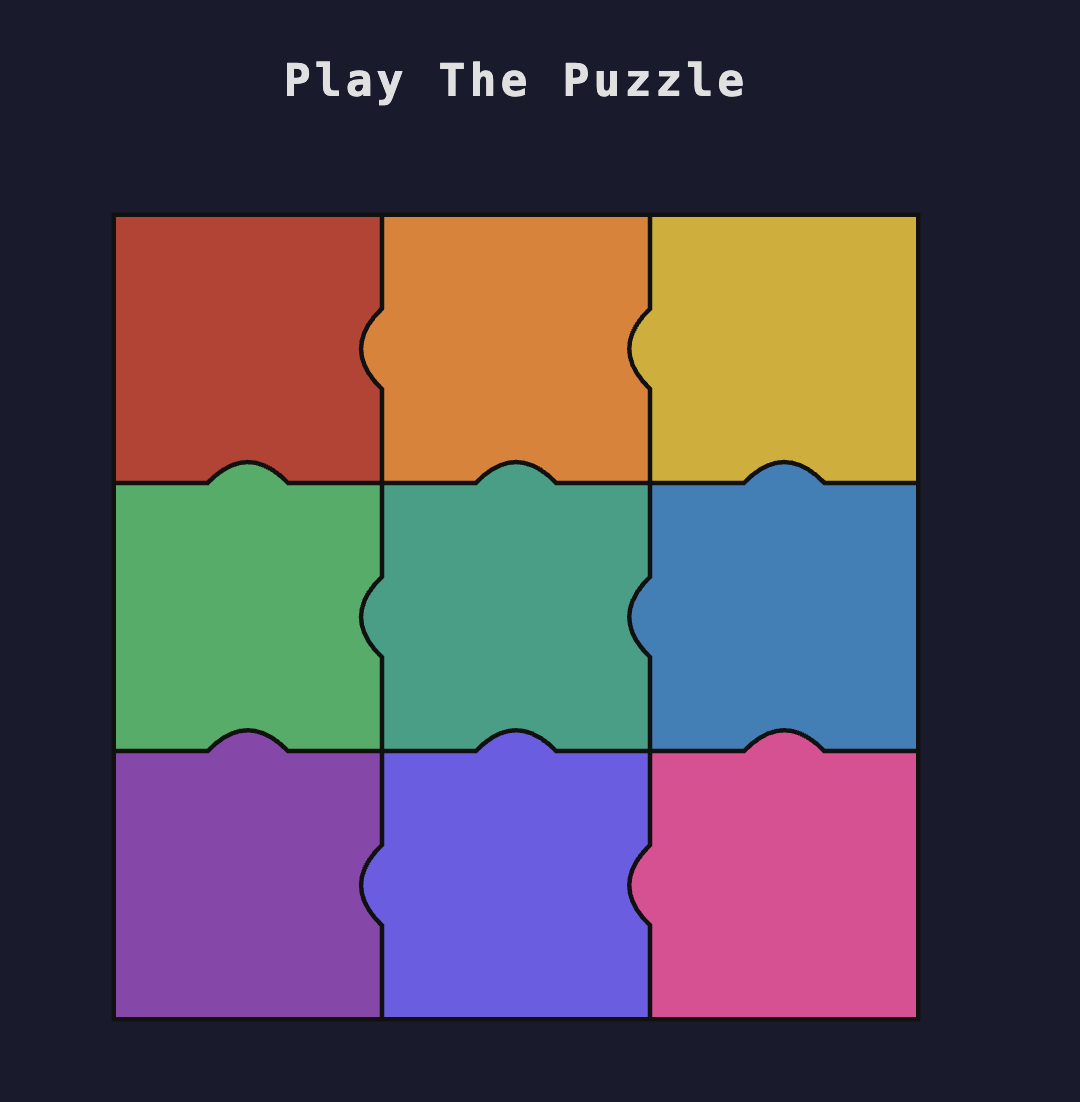
Concept and Technology Statement
Section titled “Concept and Technology Statement”I really liked the tonematrix example from the inspiration websites. I’ve always liked playing puzzles so I wanted to assign each piece of a puzzle into a note for the user to have creativity around generating a harmony the way they play the puzzle themselves. Some future steps for this could be users being able to drag and drop the puzzle pieces into the board themselves and create and replay certain harmonies. Apart from that, I want to learn more about the notes that play well with each other to be able to place them accordingly into the relevant pieces instead of just having a random set of notes appearing in the different pieces.